The problem with most 1kWh power stations isn’t capacity. It’s plugs. During an outage, the first thing everyone does is look at the side of the box and count outlets. Fridge, chest freezer, a lamp, a phone charger, the router. Three AC outlets runs out before the list does, and then you’re daisy-chaining power strips on a kitchen floor by flashlight.
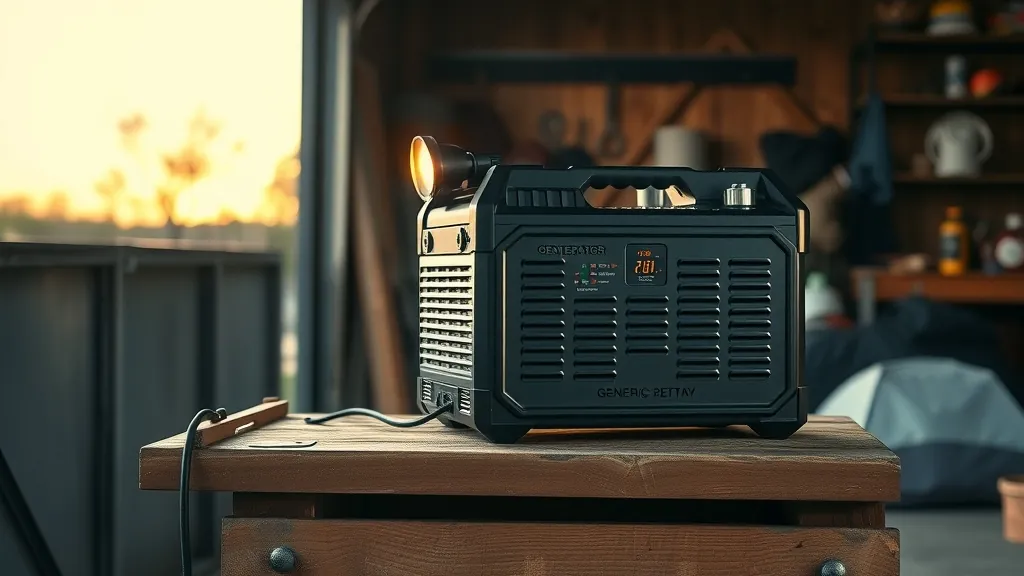
The Bluetti AC180 is one of the few units at this size and price with four full-size AC outlets, an 1,800W inverter behind them, and a wall charger fast enough to refill most of the battery during a short break in the outage. That’s the case for it. The case against is mostly weight and noise. Below is how those balance out, with the numbers sourced and labeled.
Quick verdict: at sale pricing, the AC180 is a solid stationary outage box and a decent truck-bed job-site battery. It’s a worse pick if you’re carrying it far, sleeping next to it, or expecting it to protect a desktop computer.
The numbers, and where they come from
Everything in the “Bluetti’s rating” column comes from Bluetti’s own product page and spec sheet, checked October 8, 2026. The right-hand column is what independent testers measured, or my own math where I say so.
| Spec | Bluetti's rating | Independent / real-world |
|---|---|---|
| Capacity | 1,152Wh LiFePO4 | 950Wh usable (OutdoorGearLab); 1,030Wh at a 350W load (StorageReview) |
| Cycle life | 3,500+ cycles to 80% | Rating only; nobody has run it that long in a published test |
| AC output | 4 × 120V, 1,800W continuous; 2,700W Power Lifting | Power Lifting is for heating loads, not motor surge headroom |
| Wall charging | 1,440W max; 0–80% in ~45 min | ~1.3 hr to full (OutdoorGearLab) |
| Solar input | 500W max | ~3 hr in perfect sun at full input; 6–8 hr on one 200W panel (OutdoorGearLab) |
| UPS switchover | 20ms | Fine for a TV in informal testing (The Gadgeteer) |
| Size / weight | 13.4 × 9.7 × 12.5 in; listed at 35.3 lb | 36 lb (OutdoorGearLab) |
| Warranty | 5 years | Read the seller terms if you're not buying direct |
One thing to settle before going further: the AC180P is a different product with a 1,440Wh pack. Marketplace listings sometimes blur the two, and the spec gap is big enough to change runtime estimates by a quarter. Check the model name and the capacity on the listing.
What it costs right now
Bluetti’s own page lists the AC180 at $499 when I checked on October 8, 2026, and marks it out of stock with a restock expected in late November. Meanwhile, community deal posts through 2026 have shown it at roughly $360–$404 on Amazon and AliExpress. OutdoorGearLab’s January 2026 review quoted a $799 list price, and StorageReview’s earlier review cited $1,199. That spread tells you how much “list price” means in this category: not much.
My rule from years of buying job-site equipment holds here. Never pay list for something that’s on sale every six weeks. If you need one before the restock, Amazon and authorized retailers usually have it. Make sure the seller is authorized, because that’s what the five-year warranty hangs on. All of these prices are snapshots and will have moved by the time you read this.
The standout: four outlets you can actually use
Plenty of power stations advertise “11 outputs” by counting every USB port and the wireless pad. The AC180 does that too, but the number that matters is four 120V AC outlets on the front, sharing an 1,800W ceiling. For a house in an outage, that covers a full-size fridge, a chest freezer, a lamp and a router without a power strip. On the Jackery Explorer 1000 v2 I reviewed yesterday, you get three.
Those loads also stay comfortably under the limit. A fridge and a chest freezer cycling at the same time might spike near 1,000W for a second on startup, then settle to a couple hundred watts combined. The 1,800W inverter has headroom for that. It also runs a 15A circular saw or a miter saw, which is how I’d actually use it most weekends: parked at the far end of a fence line where there’s no outdoor outlet.
About Power Lifting. Bluetti advertises 2,700W in Power Lifting mode. Read that one carefully. It’s a mode that lowers voltage so resistive heating loads, like a kettle, hair dryer or small space heater, can run above 1,800W at reduced output. It does not mean you can start a 2,700W motor. Heating appliances are also the fastest way to drain a 1kWh battery: a 1,500W kettle would take most of the pack in well under an hour. Use it for a pot of coffee, not as a way to heat a room.
The rest of the ports are four USB-A, one USB-C, a 12V car-style outlet and a wireless charging pad on top. One USB-C is my main complaint here. If two people need to fast-charge laptops, one of them ends up on a laptop brick plugged into an AC outlet, which wastes power through the inverter. The 12V port is the efficient choice for a CPAP with the manufacturer’s DC cord. Ask your doctor or the CPAP maker about running the heated humidifier on battery, since that’s what drains it fastest.
Where it gives ground: weight and fan noise
At about 35–36 lb, the AC180 is a two-hand carry for most people, and roughly 12 pounds heavier than the Jackery 1000 v2 for about 80Wh more rated capacity. OutdoorGearLab scored it low on power-to-weight for the same reason. If you’re hauling it a quarter mile to a tent site, that’s a real cost. If it lives on a garage shelf and only rides in a truck bed, it hardly matters. The body is a fairly compact cube, so it fits on a standard 12-inch-deep shelf, but keep the vents clear on both sides.
The fan is the other thing. Bluetti advertises quiet charging in its marketing, but OutdoorGearLab listed a noisy fan as a con after using it for several months. In my experience, fans on these units ramp up under heavy AC load and during fast charging, which is exactly when you’re running it in a house at night. Put it in the kitchen or a hallway, not next to a bed.
Doing the honest runtime math
Plan from the measured usable energy, not the label. Taking the conservative OutdoorGearLab figure of about 950Wh and dividing by each load’s average draw:
- Full-size fridge averaging 100–150W over a day: roughly 6–9 hours. Plug in a $20 watt meter for 24 hours and find your real number. Every homeowner I’ve worked with has guessed low on the old garage fridge.
- Fridge plus chest freezer, around 200W average combined: about 4–5 hours. A short wall-power window in a rolling outage gets most of that back, which is where the fast charging earns its keep.
- Router and modem at about 20W: well over a day. Longer if they can run off USB-C or the 12V port and skip the inverter losses.
- Circular saw cuts on a job site: dozens of cuts barely move the gauge. A table saw running all afternoon is a different job for a different power source.
These are calculated estimates under stated assumptions, not bench tests of mine. Cold weather, high loads and an older battery all cut into them.
Upkeep, warranty and the safety lines I won’t blur
Warranty. Bluetti lists five years. That’s among the better terms in this class, but it depends on buying through Bluetti or an authorized retailer. Open-box, refurbished and third-party marketplace units may be covered differently, or not at all. Register the unit and keep the receipt taped inside the manual.
Storage. Don’t let it sit for months at 0% or 100%. Check it every few months, keep it partly charged, and store it somewhere that stays near room temperature. Bluetti’s manual has the exact intervals and temperature ranges; follow those, not a forum thread. An uninsulated attic or a garage in a Phoenix July is the wrong place.
Expansion batteries. Bluetti lists the B80 (806Wh), B230 (2,048Wh) and B300 (3,072Wh) as compatible. Check Bluetti’s current compatibility notes for the connection method and cable before you budget for one. A B230 or B300 can cost as much as or more than the AC180 itself, so price the station plus battery against a bigger station from the start.
It’s not a home backup system by itself. It runs what’s plugged into it. Powering your home’s circuits takes a transfer switch or an interlock kit with a power inlet, installed by a licensed electrician, usually with a permit. Never backfeed a dryer or wall outlet with a double-male “suicide cord.” It can energize the street lines, electrocute a lineworker and start a fire inside your walls.
The UPS has limits. Bluetti’s 20ms switchover kept a TV running in The Gadgeteer’s informal test. Bluetti’s manual itself says to test the feature before relying on it to protect data. For a desktop PC or a NAS, buy a dedicated UPS.
Battery safety. Run it on a hard, dry surface with airflow around the vents. Keep it off wet basement floors and out of a closed car in summer. LiFePO4 is the more thermally stable lithium chemistry, which is why I’m comfortable keeping one in a house, but it’s still a lot of stored energy. When I searched on October 8, 2026, I found no CPSC recall notice covering the AC180. Recall status can change, so search cpsc.gov for “Bluetti” yourself, especially before buying used.
Who should buy it, and who shouldn’t
Buy the AC180 if it’ll mostly sit in one place, like a garage shelf, a utility room or a truck bed, and you want enough outlets to run a fridge, a freezer and the essentials without a power strip. Fast wall charging and a five-year warranty make it a strong outage box at sale prices in the high $300s to $400s.
Look elsewhere if you’ll carry it any real distance, it’ll run in a bedroom, or you need a true zero-gap UPS. A lighter unit like the Jackery Explorer 1000 v2 is easier to carry, and the EcoFlow DELTA 2 is the other obvious cross-shop if you want more AC outlets and a dedicated extra-battery port.
How I evaluated it: this review draws on Bluetti’s AC180 product page and specs (checked October 8, 2026), measured results published by OutdoorGearLab (January 2026) and StorageReview, The Gadgeteer’s hands-on review, 2026 deal-post pricing, and a recall search on October 8, 2026. Runtime figures are my calculations from those measured capacities, not my own bench tests. Prices, stock and warranty terms change, so confirm against Bluetti’s current listing before you buy.