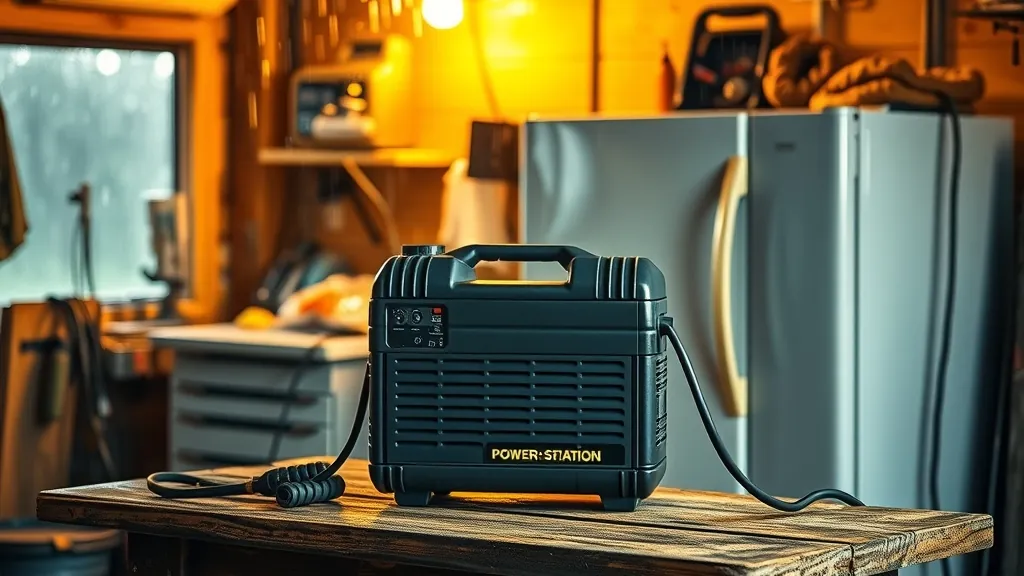
First, a disclosure about the search term. Most “best solar generators for home backup” lists rank 3-5kWh systems that cost several thousand dollars and need an electrician to wire them to the panel. This list doesn’t. All four stations below are roughly 1kWh LiFePO4 units, the size most households actually buy, and the honest job for that size is essentials backup: the fridge, the router, a few lights, phones, a CPAP. It won’t run your house. If whole-home backup is what you’re after, skip to the last section, because the decision there is really about wiring and permits, and the box you plug in comes second.
A “solar generator,” by the way, is a marketing name for a battery power station sold with solar panels. The battery is the part that does the work. The panels just refill it, slowly.
I spent years doing renovation work, and every outage call started the same way: someone had bought the biggest number on the box, then found out at 2 a.m. that the number they needed was something else. So this ranking starts with the outage, not the spec sheet.
Start with your outage, not the battery
Before ranking anything, here’s roughly what a 1kWh station buys you. Assume about 870-950Wh usable after inverter losses, which lines up with independent measurements cited in our individual reviews. These are calculated estimates, not bench tests of mine, and your appliances will differ.
| Load | Typical average draw | Rough runtime on ~900Wh | Notes |
|---|---|---|---|
| Full-size fridge | 100-150W averaged over a day | 6-9 hours | Measure yours. Older garage fridges run high. |
| Fridge + chest freezer | ~200W combined | 4-5 hours | Both compressors starting together is the surge to plan for |
| Router + modem | 15-25W | Well over a day | Longer on USB-C or 12V, which skip the inverter |
| CPAP (no heated humidifier) | Varies by machine and pressure | Often several nights | Use the maker's DC cord; ask your provider first |
| Space heater or window AC | 500-1,500W | Under 2 hours | Wrong tool. Don't plan on heating or cooling a house. |
The table makes the point most buyers miss. The difference between these four stations is not how long they run a fridge, since all four land in the same 6-9 hour window. What separates them for home use is what happens around the runtime:
- Can it grow? A two-night outage with a freezer needs 2-3kWh. Only two of these four accept an extra battery.
- How fast does it refill from the wall? Real outages flicker. Power comes back for 40 minutes, then drops again. A station that refills most of its battery in an hour turns those windows into hours of fridge time.
- How short is the switchover? If it sits plugged into the wall with your network gear behind it, a shorter gap means fewer reboots when the grid drops.
- How many AC outlets? At home you’ll run more things at once than at a campsite.
- Warranty terms and upkeep. A home unit sits idle for months, and the manuals have storage rules that can affect coverage.
Weight, the thing that decided our camping ranking, barely matters here. A unit that lives on a utility-room shelf only has to move when you set it up, so the order changes.
1. EcoFlow DELTA 2: best overall for outage essentials
The DELTA 2 wins this one for a reason that has nothing to do with being new. It isn’t. EcoFlow has moved its 1kWh line to the DELTA 3, and the DELTA 2 now sells mostly as remaining stock, which is why it has shown up near $400 in 2026 sales. At that price you get the combination that fits home backup best:
- Six AC outlets (1,800W continuous). A fridge, freezer, lamp, router and a phone-charging brick all fit without a power strip.
- 1,200W wall charging. EcoFlow quotes 0-80% in about 50 minutes, which is the feature I’d pay for in a storm-season house. A short grid window puts most of the battery back.
- One extra-battery port. EcoFlow pairs it with the DELTA 2 Extra Battery for about 2kWh total, or the DELTA Max Extra Battery for roughly 3kWh. That moves it from “one night” to “a long weekend” for a fridge and essentials.
- 500W of solar input (11-60V), enough for a pair of portable panels wired within the voltage window.
The weak spots matter for home use, so here they are plainly. EcoFlow rates the EPS switchover at up to 30ms and its own manual says not to rely on it for devices that need 0ms switching, like servers and workstations. A router usually rides through. A desktop PC may reboot. Charging is rated only from 32°F to 113°F, so an unheated garage in a northern winter is the wrong place for it. And because it’s being phased out, buy the extra battery now if you think you’ll want one. Accessories for discontinued models get harder to find.
The upkeep is real but small. EcoFlow’s manual asks for a full cycle every three months when the unit sits unused, then storage around 60%. Put it on a calendar reminder. Full details in our EcoFlow DELTA 2 review.
Pick it if you want the most practical outage setup for the money and might grow it later. Skip it if a DELTA 3 is within about $100 when you shop, or the unit will live somewhere that freezes.
2. Bluetti AC180: highest expansion ceiling, if you can live with the fan
On our camping list the AC180 came last because it weighs about 35-36 lb. At home that stops mattering, and what’s left is a strong outage box:
- Four AC outlets on an 1,800W inverter, which handles a fridge and freezer starting together.
- 1,440W wall charging. Bluetti quotes 0-80% in about 45 minutes, and OutdoorGearLab measured roughly 1.3 hours to full.
- The biggest growth path in this group. Bluetti lists the B80 (806Wh), B230 (2,048Wh) and B300 (3,072Wh) as compatible add-ons. Paired with a B300, that’s about 4.2kWh on paper, more than the DELTA 2 can reach. Check Bluetti’s current compatibility notes for the connection method first, because a B300 can cost more than the station.
- A five-year warranty on units bought through Bluetti or authorized sellers, per Bluetti’s listing.
Two things keep it at number two. Independent tests measured 950-1,030Wh usable from the 1,152Wh pack, so it’s ahead on paper but only modestly in practice. And the fan is loud enough that OutdoorGearLab listed it as a con, which hurts at home because outages often happen at night. Put it in a kitchen or hallway, not a bedroom. Its 20ms switchover sits between the Anker and the EcoFlow.
One buying note. When we checked on October 8, 2026, Bluetti’s own store listed it out of stock with a restock expected in late November, while marketplace listings still had it. Also don’t confuse it with the AC180P, a different model with a larger 1,440Wh pack. See our Bluetti AC180 review.
Pick it if the unit will stay put and you want the option to grow toward 3-4kWh. Skip it if it’ll run near where people sleep.
3. Anker SOLIX C1000 Gen 2: best always-plugged-in standby
If your plan is to leave a station plugged into the wall full time, with the modem, router, a doorbell base station and a lamp running through it, the Anker is the unit I’d use. Anker rates its switchover at 10ms, the shortest of the four. The other three quote 20-30ms. Most network gear survives either, but the shorter gap gives a marginal power supply more room.
It also has the most muscle: 2,000W continuous (Anker’s rating) across five AC outlets, and a 49-minute full recharge from the wall with UltraFast Charging switched on in the app. One catch from the jobsite side: UltraFast pulls up to 1,600W, which is most of a 15-amp household circuit. If that outlet shares a circuit with the microwave, expect a tripped breaker. Leave it in the default 1,200W mode on a shared circuit.
Why third, then? No expansion port. Anker’s own comparison table lists expandable capacity as “No.” For home backup that’s the deciding flaw, because 1,024Wh is all it will ever hold. Fine for outages that last an evening. A two-day ice storm with a freezer will outlast it, and your only upgrade path is buying a second station. The fans also get loud during fast charging or heavy draw (Notebookcheck measured about 45 dB at 1 meter), and the original C1000’s built-in light bar is gone, so keep a headlamp strapped to the handle. Our Anker SOLIX C1000 Gen 2 review has the rest.
Pick it if your outages are short and you want network gear to ride through them with the least interruption.
4. Jackery Explorer 1000 v2: a carry unit that can cover the house
The Jackery is a fine power station. It’s just built for a different job. Its strengths, about 23.8 lb and a compact body that fits a 12-inch-deep shelf, are camping and jobsite strengths. For a house it has three AC outlets, a 1,500W inverter, 400W of solar input and no expansion port. Fridge, freezer and one lamp, and you’re out of plugs.
It still earns a place for one kind of buyer: someone who wants a single unit that goes camping in summer and covers the kitchen in winter, and who weighs the carry more than the outlet count. The battery is rated for 4,000 cycles to 70%, and the switchover is rated at 20ms or less. The warranty runs three years plus a free two-year extension when you buy from an authorized seller and register. The fast one-hour charge needs the app’s emergency mode; the standard charge takes about 1.7 hours. Details in our Jackery Explorer 1000 v2 review.
Pick it if home backup is the second job, not the first.
The wiring line I won’t blur
Every one of these runs only what you plug into it. If you want the furnace blower, well pump or a dedicated circuit backed up, the way to get there is a transfer switch, or an interlock kit with a power inlet, installed by a licensed electrician, usually with a permit. Budget their time into the comparison, and let them confirm whether a given station can feed that equipment at all. Never backfeed a dryer or wall outlet with a double-male “suicide cord.” It can energize the utility line a lineworker is touching and start a fire inside your walls.
Two more safety notes from outage calls. If you top a station off from a gas generator, run the generator outdoors, well away from doors and windows, because carbon monoxide from generators is one of the leading causes of death after storms. And if someone in the house depends on powered medical equipment, talk to their provider about backup runtime, and ask your utility whether it keeps a medical-priority list.
When 1kWh is the wrong tool
Be honest about which outage you get. If yours last hours and come a few times a year, any of the top three will do. If they last days, either start with the DELTA 2 or AC180 and buy the extra battery up front, or look at a larger home-backup system designed to tie into your panel and have an electrician quote it. A box this size won’t cover a 5,000W whole-house load, however many solar panels you add.
How we ranked these: this list draws on the manufacturers’ published specs and manuals, independent measurements cited in our individual reviews (OutdoorGearLab, StorageReview, Notebookcheck, MacRumors and others), and a CPSC recall check on October 26, 2026 that turned up no recalls for these four models. EcoFlow’s 2025 recall covered the DELTA Max 2000, a different unit. I haven’t bench-tested these myself, and runtime figures are calculated estimates. Prices, stock and warranty terms change often, so check the current listing before you buy.