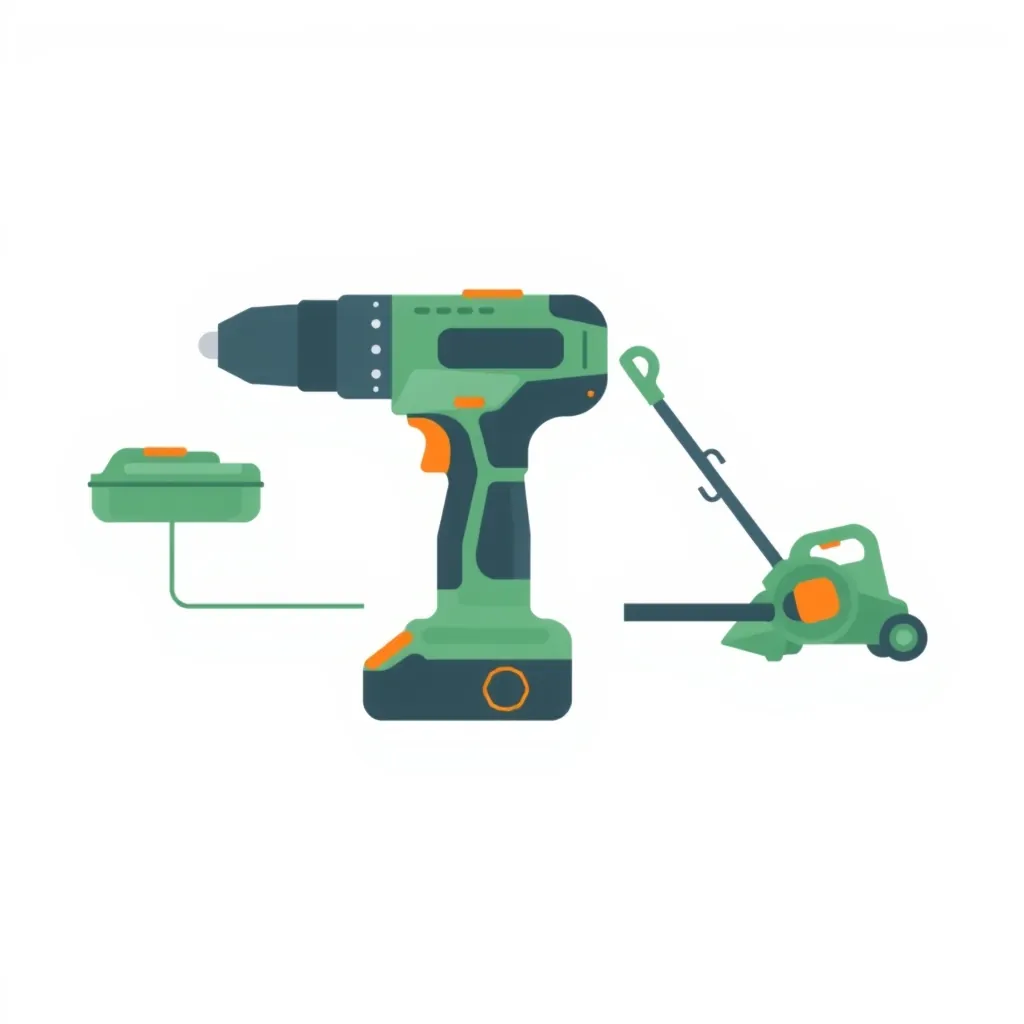
Most drill buying guides start with torque numbers. I’d start somewhere else. The drill is the cheapest part of the decision. The battery it runs on is the expensive part, because once you own two or three packs and a charger, every saw, string trimmer, leaf blower and work light you buy afterwards will come from the same brand. Pick the drill without thinking about that and you can end up with three chargers on the garage shelf and batteries that fit nothing else.
When I was running renovation jobs, the crews never argued about drills. They argued about batteries. The guy on yellow packs wouldn’t touch a red tool, and nobody wanted to haul two chargers to a site. Homeowners run into the same thing more slowly, a year or two after the first purchase.
So this guide runs in the order I’d make the decisions, and the first one gets the most space.
1. Choose the battery platform before the drill
Think about what else you will want to run in the next five years. For a yard-and-house owner, the list usually looks like this: a drill and impact driver, a circular saw or jigsaw, a string trimmer, a leaf blower, maybe a hedge trimmer or a small chainsaw, and possibly a mower.
Then check which platform covers that list in one battery family:
- Tool-first brands (the big contractor names) have deep lineups of drills, saws and specialty tools, plus a growing set of outdoor tools on the same 18V/20V class pack. Their mowers and larger blowers sometimes need two packs at once or a separate higher-voltage line.
- Homeowner-value platforms cover a very wide range of tools at lower prices. Ryobi says its 18V ONE+ batteries have fit every ONE+ tool since the system launched in 1996, which is the kind of backward compatibility you want. Its mowers and bigger outdoor tools, however, mostly sit on a separate 40V line that does not share batteries with the 18V drill.
- Outdoor-first brands built their platforms around mowers, trimmers and blowers at higher voltages. Some have added a drill, but the selection of hand tools is much thinner than the tool-first brands.
There is no single right answer. What matters is that you check the specific tools you want are sold on the battery you are about to buy into, and that the brand has kept that battery compatible over time. A platform that changes its battery connector every few years is the worst outcome, because your old packs stop being useful.
Two practical checks while you’re at it:
- Price a spare battery and charger separately. Bare batteries are often a large share of the kit price. If a kit includes two batteries, that is usually the cheapest time to get them.
- Look at “bare tool” prices. Once you own batteries, every later tool can be bought without them. A platform with reasonably priced bare tools saves real money over the years.
If you already own batteries from a brand, the decision is mostly made. Buy the drill that fits them unless the platform genuinely lacks something you need.
2. Ignore the 18V vs 20V argument
This one causes more confusion than it deserves. An “18V” pack and a “20V MAX” pack in this class are the same thing: five lithium-ion cells in series. Each cell sits around 3.6V under normal use and peaks near 4.0V right off the charger. Five times 3.6 is 18; five times 4.0 is 20. DeWalt’s own fine print says the maximum initial voltage, measured without a workload, is 20V and the nominal is 18V.
So a 20V MAX drill is not more powerful because of its label. Compare the stated torque (often given in inch-pounds, or as “unit watts out” by some brands), the top speed in RPM, and which tier of the brand’s lineup the drill belongs to.
The real voltage decision is between classes:
| Class | Good for | Trade-off |
|---|---|---|
| 12V | Furniture, hanging shelves, cabinet hardware, small pilot holes | Less torque and runtime for big bits or long screws |
| 18V / 20V MAX | Almost every house and yard job, deck repairs, fence boards | Heavier, especially with a large battery |
| Higher-voltage (36V and up) | Mowers, big blowers, heavy outdoor tools | Few drills, heavy, expensive packs |
For one drill that does everything around a house and yard, the 18V/20V class is the default.
3. Brushless or brushed
A brushless motor uses electronics instead of carbon brushes to switch the current. In practice that usually means longer runtime per charge, a bit more power for the size, and no brushes to wear out. Brushed drills are cheaper and perfectly adequate for occasional use.
My rule: if you drill or drive screws a few times a month, a brushed drill will last for years. If you’re planning a deck, a fence or a shed, spend the extra on brushless. You will notice the runtime difference on the second day of driving screws.
4. Chuck size: 1/2-inch for one drill, 3/8-inch for a compact
The chuck is the clamp at the front that holds the bit. A 1/2-inch chuck accepts larger shanks, which matters for big spade bits, hole saws and mixing paddles. Most 18V/20V drill/drivers have one. A 3/8-inch chuck is common on 12V compacts and is fine for small bits.
Check that the chuck is keyless and has a ratcheting or locking action. A cheap chuck that slips under load is one of the most common complaints on budget drills, and you can’t fix it with a better battery.
5. Clutch settings, speed range and the feel in your hand
The clutch stops the drill from turning once it hits a set resistance, so you don’t strip screw heads or sink screws too deep into softwood. Look for a clutch with a decent number of settings and a separate drill mode. Two speed ranges, a low gear for driving and a high gear for drilling, are standard on anything worth buying.
Then go and hold it. Weight with the battery attached matters more than the bare-tool weight on the box, and a drill that feels fine for one hole gets heavy overhead after twenty. Check that the trigger gives fine control at low speed and that the LED light actually lights the bit tip rather than the chuck’s shadow.
6. Decide whether you need a hammer drill or an impact driver
These are two different tools that often get bundled:
- A hammer drill adds a pounding action for masonry. If you regularly drill into brick, concrete block or a concrete slab, get one. If you hang a TV on a brick wall once every few years, a masonry bit in a regular drill or a borrowed hammer drill will do.
- An impact driver is a separate tool with a quick-change hex collet and rotational impacts. It drives long deck screws and lag bolts far more easily than a drill, with less strain on your wrist. For yard projects like decks, pergolas and raised beds, a drill plus impact driver kit is the most useful pairing you can buy.
7. Read the warranty for both tool and battery
Tool warranties and battery warranties are often different lengths, and the battery is the part that wears out. Check:
- How long the tool is covered and how long the battery is covered, which may be shorter.
- Whether coverage requires registration, and whether it only applies to the original buyer with a receipt.
- Whether the warranty is handled through a local service center or means mailing the tool away.
- Whether a “lifetime” or extended claim has conditions in the fine print, such as covering only certain parts.
Terms change by model, brand and retailer, so read the current terms on the maker’s site before you buy instead of trusting a forum post.
Battery safety and care
Lithium-ion packs are safe when treated well, but they deserve some respect:
- Use only the manufacturer’s charger and batteries. Cheap knockoff packs often skip protection circuits.
- Don’t charge or store packs in a hot car, in direct sun, or in a freezing shed. Room temperature is best.
- Stop using any battery that is swollen, cracked, leaking or gets unusually hot, and recycle it through a battery drop-off program rather than the household trash.
- Follow the drill’s manual on bit selection, clutch use and eye protection. Wear safety glasses when drilling, especially overhead or into masonry.
If you’re drilling into walls, check for wiring and pipes first with a stud finder that detects live wires. Anything involving new circuits or moving outlets is a job for a licensed electrician, not a cordless drill and a weekend.
A quick decision path
- Mostly furniture, pictures and small fixes: a 12V brushed or brushless drill with a 3/8-inch chuck.
- General house and yard owner: an 18V/20V brushless drill/driver with a 1/2-inch chuck and two batteries, on the platform that covers your outdoor tools.
- Planning a deck, fence or shed: the same drill plus an impact driver, and an extra higher-capacity battery.
- Regular masonry work: step up to a hammer drill in the same platform.
Prices move with seasonal sales, so compare current listings, and remember that the kit with two batteries is usually the better deal than the drill alone. When you’re comparing yard tools to go with it, see our gear reviews.