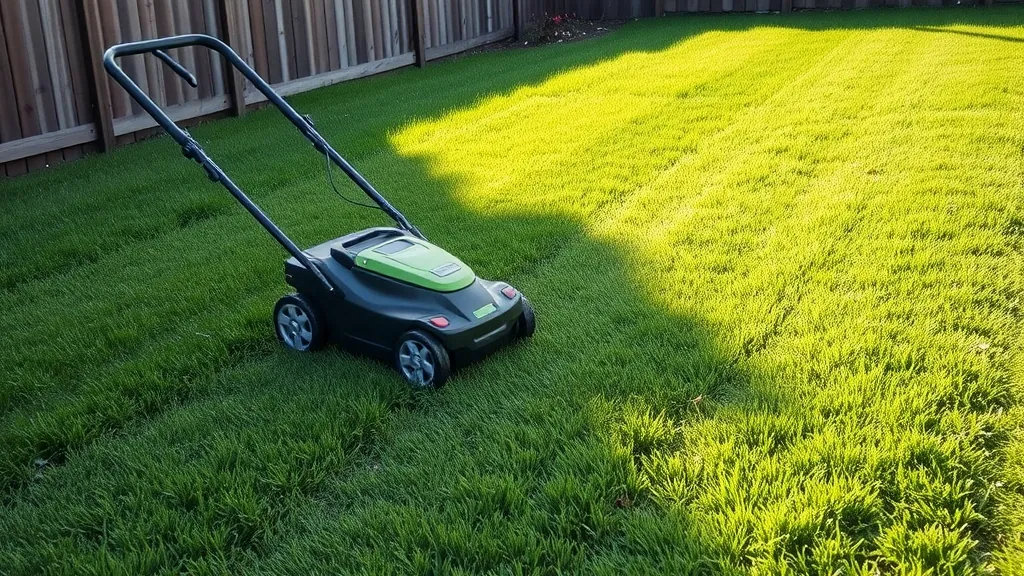
Here’s the situation I keep running into on renovation jobs: a homeowner has a gas mower that won’t start every April, a gas can going stale in the shed, and a lawn somewhere between a quarter and a half acre. They’re not after a riding mower. They want something that starts every time, doesn’t need a carburetor rebuild, and can hang on the garage wall. If that’s you, the Greenworks 80V 21-inch self-propelled is one of the first battery mowers I’d put on your shortlist. The catch is that “the Greenworks 80V mower” is actually half a dozen SKUs with different batteries, and the one you buy decides whether you finish your lawn on one charge.
How I put this together: I haven’t run this mower through a season myself, and I won’t pretend otherwise. Specs, runtimes and prices come from Greenworks’ own US and Canadian product listings and from retailer listings I checked in October 2026. Warranty terms come from Greenworks’ published warranty page. Recall status comes from Greenworks’ safety notices page and the CPSC database. Hands-on cutting, bagging and noise results come from John Peachey’s review at A Concord Carpenter, which tested the 5.0Ah Pro 80V 21-inch over six mows. Where a number is a manufacturer rating rather than something a tester measured, I say so.
If you’re replacing a gas mower, here’s the honest comparison
A typical 21-inch gas self-propelled mower gives you unlimited runtime as long as there’s fuel in the can. In exchange you get an annual oil change, a spark plug, an air filter, stabilizer every fall, and the spring ritual of yanking a cord. Most of the “won’t start” calls I’ve fielded over the years came down to fuel left in a carburetor over winter.
The Greenworks trades all of that for a battery budget. Here’s what Greenworks claims for the main 21-inch self-propelled bundles:
| Bundle (as listed) | Battery | Rated runtime | Rated coverage |
|---|---|---|---|
| Single 4.0Ah kit (e.g. SKU 2515902) | 4.0Ah / 288 Wh | Up to 45 min | Up to 1/2 acre |
| Single 5.0Ah kit (e.g. SKU 2502402) | 5.0Ah / 360 Wh | Up to about 60–70 min | Up to about 1 acre (per listing) |
| Dual-port kit, 2 x 4.0Ah (e.g. SKU 2533902) | Two 4.0Ah | Up to 80 min | Up to 3/4 acre (Lowe’s listing) |
Those are manufacturer ratings, and they don’t agree perfectly across listings. One Greenworks Canada page quotes 70 minutes for the 5.0Ah kit, while a US page says “up to 1 hr.” Treat them as best case on dry, regularly cut grass with the self-propel used gently.
What the one real-world data point I trust says: Peachey’s lawn normally takes 30 to 35 minutes to mow, and he got through it almost three times on one 5.0Ah charge. He wasn’t using the self-propel, because his yard is close to flat. So call it 90-plus minutes of push mowing on a 5.0Ah pack, which suggests the rating isn’t inflated. Self-propel draws extra power to drive the wheels, so expect less if you lean on it.
My rule of thumb: if your lawn takes you more than 40 minutes with a gas mower, buy the 5.0Ah kit or the dual-battery kit, not the single 4.0Ah. A second 4.0Ah battery bought later costs real money, and it’s usually cheaper inside a bundle.
Where it competes against other battery mowers
Most people choosing this mower are also looking at EGO, Ryobi 40V and the big-box house brands. I’m not going to make up head-to-head runtime numbers I haven’t verified. Here’s how I’d frame the decision instead:
- Battery platform matters more than the mower. You’ll probably buy a trimmer and a blower too. Greenworks’ 80V line covers both, and combo kits with a mower, trimmer and blower have shown up at Lowe’s for around $499 to $549 in 2026 deal posts. If you already own another brand’s batteries, that usually decides it.
- Price varies more than performance does. I saw the single-4.0Ah 21-inch kit listed at $509.99 on sale (against $599.99 regular) on Greenworks’ US site, $699.89 at Walmart, and in deals as low as $429–$439 at Amazon in late 2025. That’s a $270 spread for essentially the same machine. Don’t buy at the high end of that range.
- Deck size. Greenworks also sells 80V 22-inch Pro and 25-inch dual-blade self-propelled models. The 25-inch makes sense past half an acre. Walmart listed one with a 5.0Ah battery at $999.99, and a deal post showed Lowe’s selling a 4.0Ah version for about $600 on sale. For most lots under half an acre, the 21-inch is easier to store and turn.
The deep dive: cutting, bagging and the self-propel
Cut quality. This is where battery mowers used to fall short, and where this one doesn’t. Peachey reported no uncut blades across six mows and said it cut as well as any gas mower he’d used. Greenworks says its “SmartCut” feature adjusts power to match grass thickness. On the Pro version he tested, a turbo mode takes the blade from 2,800 to 3,200 RPM.
Bagging. The rear bag needed emptying twice in about 35 minutes of mowing, cutting no more than a third of the grass height at a time. That’s normal for a 21-inch bagger. The bag itself is light and easy to clip on and off. The mower is a 3-in-1 (bag, mulch, side discharge), but the review didn’t test mulching or side discharge, so I can’t tell you how it mulches wet spring grass.
Self-propel. It’s rear-wheel drive with variable speed. The Pro spec sheet lists 1.9 to 4.9 feet per second. Rear-wheel drive is what you want on a slope or with a full bag, because the weight sits over the drive wheels. It’s a little clumsier than front-wheel drive on a flat lawn with lots of turns, and one Slickdeals owner complained about exactly that.
Cutting height. Expect seven positions from 1-3/8 to 3-3/4 inches on a single lever on the current 21-inch listings. The Pro version Peachey tested listed six positions up to 4 inches. If you keep a cool-season lawn tall in summer, check the exact SKU’s top setting.
Noise. Peachey measured 80 dB with the blade spinning over a hard surface, and quieter over grass. It’s not silent, but it’s far below a gas mower, and you can mow at 7 a.m. without the neighbors hating you.
The fine print: warranty and what it doesn’t cover
Greenworks advertises a 4-year limited warranty on 80V tools and batteries. That covers the battery for the same term as the tool, which is the expensive part to replace. But read the terms on Greenworks’ published warranty page before you count on it:
- Commercial use gets 90 days, not four years. If you mow a neighbor’s lawn for cash, you’re in a gray area.
- Proof of purchase and product registration are required. Register the day it arrives. It takes five minutes.
- Wear items and maintenance are on you. Blade sharpening and lubricants are excluded, and so are parts subject to normal wear. The blade, and probably the bag over time, count as consumables.
- Unauthorized sellers void it. Third-party marketplace sellers are the risk here, so check that the seller is an authorized dealer.
- Battery claims go through a self-service form. Everything else needs a return authorization from Customer Care first.
- Shipping: on the Canadian terms, getting the mower to and from an authorized service provider is your cost. If Greenworks accepts a direct warranty return, it pays return shipping.
An older Greenworks warranty text quoted on a 2021 forum split the battery coverage into shorter terms. The current published terms I found say four years for both. Greenworks also says your owner’s manual governs the exact period, so check the manual in your box.
Upkeep, realistically
Here’s the maintenance list compared to gas:
- After each mow: pull the battery, then knock clippings off the underside with a plastic scraper or a stick. Keep water away from the motor housing and the battery port, and follow the manual’s cleaning instructions. Pull the battery first, every time, before you reach under the deck.
- Mid-season: sharpen or replace the blade. A sharpened blade alone fixes most “it’s tearing the grass” complaints. You’ll need a socket wrench, gloves and a block of wood to stop the blade turning. Get the bolt size, torque and blade orientation from the manual for your SKU.
- End of season: clean the deck, and store and charge the battery the way your manual specifies. Keep it out of a shed that bakes in summer or freezes in winter.
- Never: oil, fuel, spark plugs, air filters, carburetor cleaner.
My rough estimate is a couple of hours a season, well under what a gas mower takes once you count the spring no-start.
Safety notes
- Slopes. Greenworks’ walk-behind FAQs say not to run these mowers on slopes steeper than 15 degrees, and to mow across a slope rather than up and down. On a steep bank, that’s a job for a string trimmer.
- Battery care. Lithium packs don’t like heat, crushing or water. Don’t charge a battery that’s been dropped hard or looks swollen. Take it to a battery recycler instead of the trash.
- Recall check. I found no recall for any Greenworks 80V mower. Greenworks has issued a safety notice for some 60V 22-inch self-propelled mowers (models MO60L811 and MO60L521), and recalled 80V chainsaws in 2018. If you’re buying used, check the model and date code against cpsc.gov.
Who should skip it
- Lots over about 3/4 acre unless you’re happy buying a second or third battery. Look at Greenworks’ 25-inch or a battery rider instead.
- Steep, hilly yards. A 74 lb mower on a slope is work even with rear-wheel drive, and the 15-degree limit rules out a lot of embankments.
- Anyone mowing for pay. The 90-day commercial warranty term makes this the wrong tool. Greenworks sells a separate commercial line.
- People who let the lawn go three weeks between cuts. Battery mowers handle overgrown grass worse than gas. You’ll be raising the deck and double-cutting.
Verdict
For a quarter to half acre of reasonably flat lawn, the Greenworks 80V 21-inch self-propelled is an easy recommendation. The cut quality holds up, the warranty is longer than most, and storing it upright gets a gas mower’s footprint off your garage floor. I’d give it 4.2 out of 5. It loses points for weight, for a confusing pile of SKUs, and for a price that depends far too much on where you shop.
What to actually buy: the 5.0Ah kit or the dual-battery 2 x 4.0Ah kit, from an authorized retailer, and only when it’s on sale. Prices change constantly, so check the current listing and the exact model number before you check out. Then register it the day it arrives.