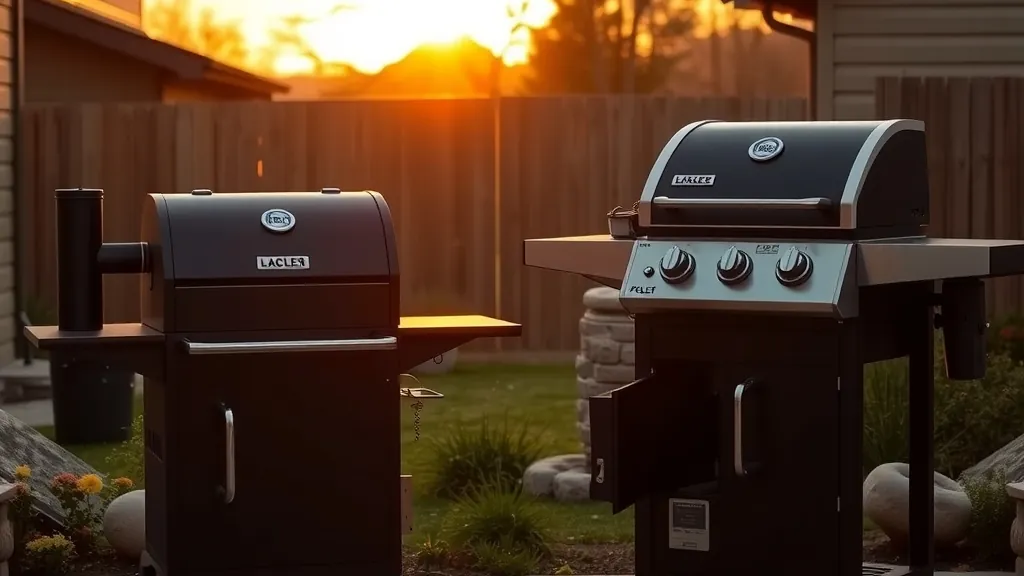

Most people comparing a pellet grill with a gas grill are really comparing two different weekends. One is a Saturday spent babysitting a brisket. The other is a Tuesday night where dinner has to be on the table in twenty minutes. Before you look at brands, work out which of those you are, because the answer changes the rest of this decision.
I spent years on renovation jobs where the grill was the one appliance every crew had opinions about, and the pattern I saw was consistent. People bought for the dream cook and then used the grill for the boring one. I’ll try to keep that in view below.
The short version
| Pellet grill | Gas grill | |
|---|---|---|
| Needs household power | Yes, for controller, auger and fan | No (unless it has lights or a rotisserie) |
| Fuel | Wood pellets, bought by the bag | Propane tank or a natural gas line |
| Best at | Smoking, long cooks, steady temperatures | Fast heat, hard searing, quick meals |
| Preheat | Several minutes while the fire pot lights | Usually a few minutes with a lid on |
| Typical upfront price | Higher | Lower for a comparable size |
| Failure points | Auger, igniter, controller, fan | Burners, igniter, regulator, hoses |
Prices swing a lot by size and season, so check current listings rather than trusting any number in a blog post, including mine.
Power: the question most buyers skip
A gas grill works during a blackout. A pellet grill does not. Its digital controller, the auger that feeds pellets and the fan that moves air all draw household electricity. The draw is modest while running, but it is not zero, and the startup phase uses a heating element to light the fire pot.
This matters in three practical ways:
- Outlet distance. If the spot you want for the grill is across the yard, you need an outdoor-rated extension cord of an appropriate gauge, or an outlet installed by a licensed electrician. Do not run a light-duty indoor cord across a wet lawn.
- GFCI protection. Outdoor outlets are required to be GFCI protected under common electrical codes. If your outlet trips when the grill starts, do not defeat it. Have it checked.
- Outages. A power cut mid-brisket ends the cook. A portable power station can bridge a short gap if its inverter can handle the grill’s startup draw, but check the grill manual and the station’s surge rating before you count on it. Wiring anything into the house for backup needs a licensed electrician.
If your yard has no practical outlet, that alone can settle the question in favor of gas.
Fuel cost: the numbers are softer than the marketing
Vendors love to publish per-hour fuel math, and almost all of it comes from someone selling one fuel or the other. Treat it accordingly.
What I’m comfortable saying: pellet grills commonly burn somewhere around 1 to 1.5 pounds of pellets per hour at low smoking temperatures, and noticeably more at high heat. Propane use depends on burner output and how many burners you light, and a standard 20-pound tank runs a typical grill for a number of hours that varies a lot with how you cook.
What I would do instead of trusting a table: look at what a bag of pellets and a tank exchange or refill cost at the store you actually use, and multiply by your usual cook length. A long smoke and a ten-minute burger session cost very differently on both fuels.
Two hidden costs people forget. Pellets must stay dry, because damp pellets swell and jam the auger, so you need storage that is not a damp garage floor. And propane tanks have to be exchanged or refilled on a schedule that never lines up with when you run out, so most gas owners eventually buy a second tank.
Flavor and cooking style
Pellet grills hold a set temperature automatically and produce a light, steady smoke. That is what they are for. Chicken thighs, ribs, pork shoulder and smoked salmon are all easy. Smoke from pellets is subtler than from a stick-burner or charcoal, which suits some people and disappoints others who want a heavy smoke ring and bark.
Gas grills are about heat on demand. Burgers, steaks, vegetables and skewers all do well, and you can adjust zones by turning knobs rather than waiting for a controller to catch up. Gas does not add smoke flavor by itself. Smoker boxes and tubes help a little, but if smoking is the point you will be fighting the tool.
Searing is the one place where the gap is real. Many pellet grills cap out well below what a hot gas grill delivers, and the heat is indirect unless the model includes a direct-flame feature. Some hybrids add a sear zone, such as the electric-and-wood-pellet design in the Ninja Woodfire, but check the claimed maximum temperature against reviews that measured it.
Upkeep and what actually breaks
On a renovation site, you learn to ask what the repair looks like before you buy. Here is what I’d expect:
- Gas: Burners corrode and clog, igniters stop clicking, and the grease tray fills. Replacement burners and igniters are cheap, widely stocked and a screwdriver-and-twenty-minutes job. Hose and regulator checks matter for safety, and I’ll cover that below.
- Pellet: Ash builds up in the fire pot and has to be vacuumed out regularly or the grill struggles to light. Grease accumulates under the drip tray and can ignite, so cleaning is not optional. The auger motor, igniter rod and controller are the parts that cost real money when they fail.
Pellet grills therefore trade simpler cooking for more complicated machinery. If you are the sort of person who dislikes troubleshooting, that is worth weighing against the convenience.
Warranty fine print
Read the warranty before the spec sheet. Look for:
- Which parts are covered, and for how long. Many warranties split the body, the burners or electronics, and consumables into different periods.
- Whether covered electronics include the controller and the auger motor, or only the shell.
- Whether the warranty depends on registering the product, and whether it is limited to the original purchaser.
- Whether you can get replacement parts for several years after the model is discontinued.
Warranty terms change by model year and by retailer, so I am not going to quote periods here. For two examples on this site, see the Traeger Ironwood and the Weber Genesis, and then check the maker’s current terms before ordering. Be wary of any listing that promises “lifetime” coverage without saying what is covered.
Safety you should not skip
- Use any grill outdoors only, well away from the house, deck rails, eaves and overhanging branches. Follow the manufacturer’s stated clearances. Never run one in a garage or under a covered porch unless the manual explicitly allows it.
- For gas: leak-test connections with soapy water each season and after changing a tank. If you smell gas, shut off the tank valve and keep flames away. Replace cracked hoses. If you have a natural gas line, the hookup should be done by a licensed professional.
- For pellets: clean grease out regularly, keep pellets dry and use only pellets approved by the manufacturer. Do not leave the grill unattended during startup, and keep the lid closed during flare-ups.
- Keep a fire extinguisher rated for grease fires within reach, and never use water on a grease fire.
So which one should you buy?
Buy a pellet grill if:
- You want to smoke meat regularly, and you’ll actually tend a long cook on weekends.
- You have a reliable outdoor outlet within reach, or are willing to have one installed.
- You’d rather set a temperature than manage vents or burners, and you can store dry pellets.
Buy a gas grill if:
- Most of your cooking is weeknight, fast and hot.
- Your grill spot has no power, or you want it to work in a blackout.
- You want the lowest upfront cost and the simplest, cheapest repairs.
Consider both if you cook often for a crowd, since many households with space end up with a gas grill for speed and a pellet unit for the weekend smoke. If you can only afford one, buy for the cook you do most, not the one you imagine.
When you are ready to compare models, start with our grill reviews and check current prices and warranty terms at the manufacturer before you buy.